
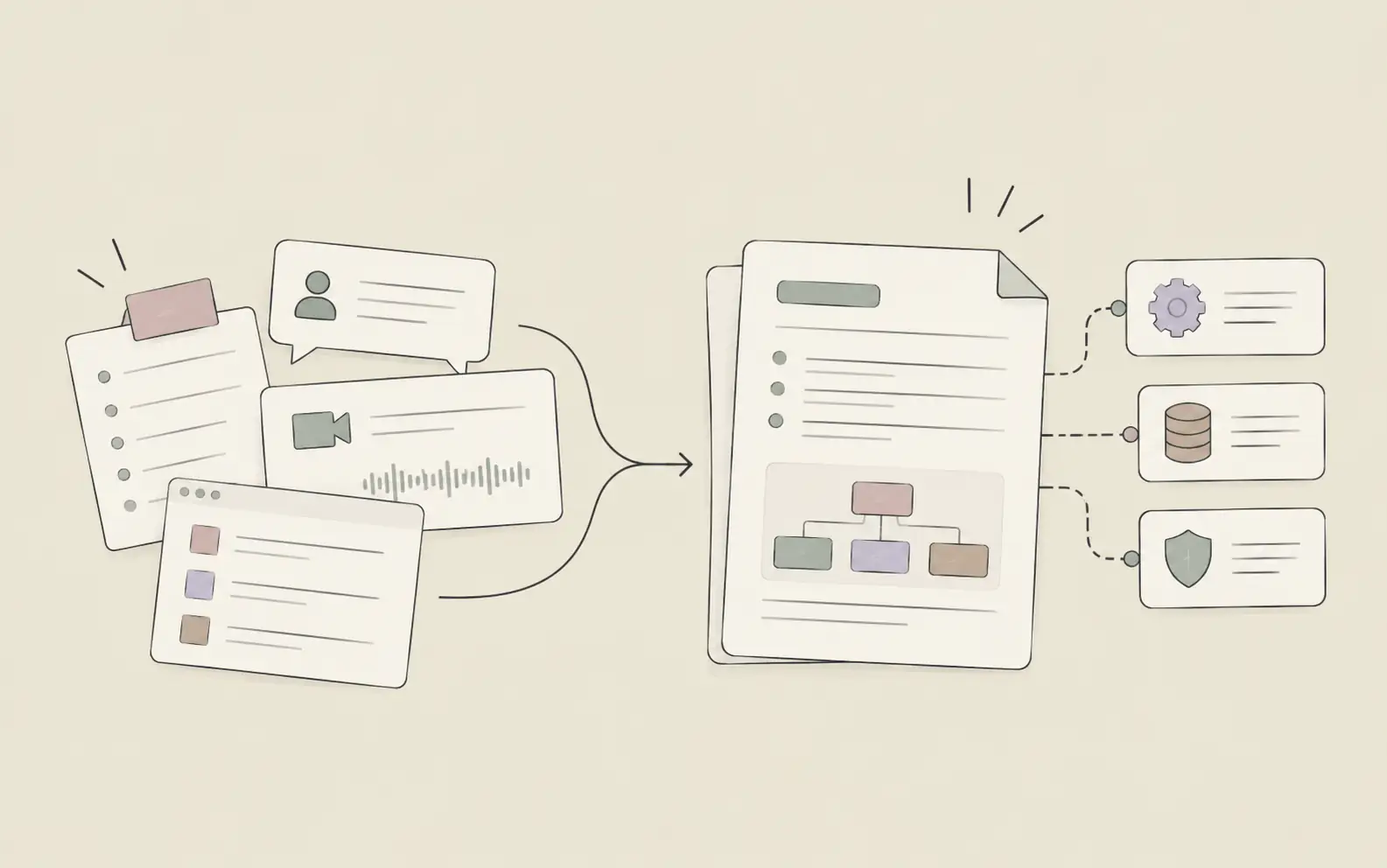
The discovery calls are done, the whiteboard sketches are in someone's notebook, and now you're staring at a blank document trying to turn three weeks of technical conversations into something a customer's engineering team can actually sign off on. A technical scope of work isn't a proposal — it doesn't talk about pricing or contract terms. It's the document that says, in plain and specific language, exactly what will be built or integrated, what assumptions the delivery depends on, which systems and teams are prerequisites, and — just as importantly — what falls outside the boundary. Get this vague, and you're setting up a change-order argument three months into implementation.
The problem is that most of this information already exists somewhere: in discovery call notes, in a Slack thread with the customer's architect, in a half-finished requirements list. Turning that scattered material into a clean, structured scope document is where solutions engineers lose hours — hours that usually come out of the next deal's discovery time. This guide walks through six steps for drafting a technical scope of work with AI, using the requirements and constraints you already gathered during discovery instead of starting from a blank page.
What You'll Need
- Discovery call notes, transcripts, or summaries with the customer
- A list of technical requirements and constraints already identified
- Names of the systems, environments, or teams involved on the customer side
- An existing scope of work template, if your team has one (not required, but helpful)
How to Write a Technical Scope of Work with AI: 6 Steps
Step 1: Consolidate Your Discovery Notes Into One Working Source
Before you can define boundaries, you need everything you learned during discovery in one place — not spread across call recordings, a shared doc, and your own memory. Pull together your discovery notes, any requirements lists, and technical constraints the customer mentioned (data volumes, existing tooling, security requirements, integration points) into a single working file. This step alone usually surfaces gaps you didn't notice mid-conversation.
If you've been logging discovery details in a persistent workspace as you go, this step is mostly retrieval rather than re-typing. Because the requirements and constraints you captured earlier stay attached to the deal, you can pull them straight into the draft instead of reconstructing them from memory or old call notes.
Try this with Noumi: "Pull together everything we captured from the discovery calls with [customer name] — technical requirements, constraints, and any open questions — into one consolidated list I can use to draft the scope of work."
Tip: Flag anything you're still unsure about here rather than guessing later. An unresolved question is easier to fix in step 1 than after the document is drafted.
Step 2: Define What's In Scope and What's Explicitly Out
This is the section that prevents the most disputes later, and it's the one teams write too loosely. "In scope" should describe the specific deliverables, integrations, or configurations you're committing to — not the general outcome the customer wants. "Out of scope" should be just as explicit: name the systems, features, or use cases that were discussed but won't be part of this engagement. Vague scope language ("standard integration support") is where change requests come from six weeks in.
Write both sides as declarative statements, not a single paragraph of prose. A reader skimming the document should be able to tell in ten seconds whether a specific request falls inside or outside the agreed boundary.
Try this with Noumi: "Based on the consolidated discovery notes, draft an 'In Scope' and 'Out of Scope' section for the technical scope of work. Use short, specific bullet statements — no vague language like 'as needed' or 'standard support.'"
Example output:
- ✅ In scope: One-way sync of customer records from [System A] to [System B] via existing API, refreshed every 15 minutes
- ✅ In scope: Field mapping for the 12 fields identified in discovery (see Appendix A)
- ⚠️ Out of scope: Historical data backfill beyond 90 days
- ⚠️ Out of scope: Custom reporting dashboards on top of synced data
Step 3: Turn Technical Requirements Into Explicit Assumptions
Every technical requirement gathered during discovery rests on an assumption, and those assumptions need to be written down, not left implicit. If the integration depends on the customer's API supporting webhook delivery, or on a specific authentication method being available, or on a minimum data volume that doesn't change mid-project, say so directly. Assumptions are what protect both sides when reality during implementation doesn't match what was discussed in a discovery call two months earlier.
Go back through your consolidated notes and separate "things we confirmed" from "things we're assuming based on what we were told." Both need to be in the document, but they should be labeled differently so the customer's technical team can verify the assumptions before sign-off.
Try this with Noumi: "Review the discovery notes and draft a 'Technical Assumptions' section. Separate confirmed technical facts from assumptions we're making based on what the customer described but didn't formally verify."
Example output:
- Confirmed: Customer's API supports OAuth 2.0 authentication (verified on discovery call, Sept 10)
- Assumed: Average daily record volume will remain under 50,000; not independently verified
- Assumed: Customer's IT team will provision a dedicated service account within 5 business days of kickoff
Step 4: Map Dependencies and Prerequisites
A technical scope of work is also a list of everything that has to happen before or alongside delivery, and on whose side that responsibility sits. This includes access provisioning, sandbox environments, third-party API credentials, security or compliance reviews, and any prerequisite work the customer's team owns. Dependencies that go unstated are the most common reason a delivery timeline slips — not because the work was hard, but because nobody flagged that a firewall rule change had to happen first.
Go through the requirements and assumptions you've already documented and ask, for each one, "what has to be true or in place for this to work?" List each dependency with who owns it and roughly when it needs to be resolved relative to the project timeline.
Try this with Noumi: "List every dependency and prerequisite this project relies on based on the requirements and assumptions already drafted. For each one, note whether it's owned by us or by the customer, and when it needs to be resolved."
Example output:
- Dependency: Sandbox environment access — Owner: Customer IT — Needed before: Kickoff
- Dependency: API rate limit increase approval — Owner: Customer — Needed before: Week 2
- Dependency: Internal security review of data handling — Owner: Us — Needed before: Kickoff
Step 5: Structure the Draft Using a Consistent Template
Once the individual sections exist, they need to sit inside a structure your team — and the customer's technical reviewers — will recognize every time. A consistent structure (scope boundaries, assumptions, dependencies, exclusions, technical prerequisites, sign-off) makes the document easier to review and harder to argue with later, because reviewers know exactly where to look for the answer to "does this cover X?"
If your team already has a standard structure for these documents, save it once as a reusable template rather than rebuilding it deal by deal. That way every new scope of work starts from your team's own standard shape instead of a blank page, and the sections stay consistent even when different solutions engineers are writing them.
Try this with Noumi: "Save this section structure — Scope Boundaries, Technical Assumptions, Dependencies, Exclusions, Prerequisites, Sign-Off — as our standard technical scope of work template so future drafts start from it automatically."
Tip: A shared template also makes it faster for a second reviewer — a solutions architect or delivery lead — to sanity-check the document before it goes to the customer.
Step 6: Assemble, Tighten Language, and Export for Review
With every section drafted, pull the document together into one clean file and go through it once specifically hunting for ambiguity — words like "reasonable," "standard," or "as appropriate" that sound fine in conversation but create disagreement in a signed document. Then generate the final version in whatever format your reviewers and the customer's technical team need to sign off on, whether that's a shareable document or a PDF for a formal review cycle.
Read the exclusions section out loud one more time before sending it. If a stakeholder on either side could reasonably argue a request falls in a gray area, it isn't specific enough yet.
Try this with Noumi: "Assemble the full technical scope of work from the sections we've drafted, tighten any vague or ambiguous language, and export it as a Word document formatted for customer review."
Example output: A structured document with numbered sections (Scope Boundaries, Assumptions, Dependencies, Exclusions, Prerequisites), ready to route to the customer's technical lead for sign-off.
Pro Tips for a Tighter Technical Scope of Work
- Write exclusions with the same specificity as inclusions. A one-line "out of scope" list next to a three-paragraph "in scope" section is a sign the exclusions weren't thought through.
- Keep commercial terms out entirely. Pricing, payment schedules, and contract language belong in the proposal, not in the technical scope — mixing the two makes both documents harder to update independently.
- Version every draft. Discovery findings shift as you talk to more stakeholders on the customer side; a dated version history saves you from arguing over which assumptions were true when.
- Get a second technical reviewer before it goes out. Whoever wrote the discovery notes has blind spots about what they assumed was "obvious" and never wrote down.
Frequently Asked Questions
Getting Started
A technical scope of work is only as strong as the discovery work behind it, and turning that discovery into a clean, boundary-setting document shouldn't cost you another afternoon of copy-pasting between notes and a template. Solutions engineers and technical pre-sales teams looking to speed up this stage of the deal cycle can see how the earlier discovery work feeds directly into scope drafting in this guide to technical discovery and POC building, or explore how Noumi supports solutions engineers across the pre-sales cycle to start drafting your next scope of work with less manual assembly.